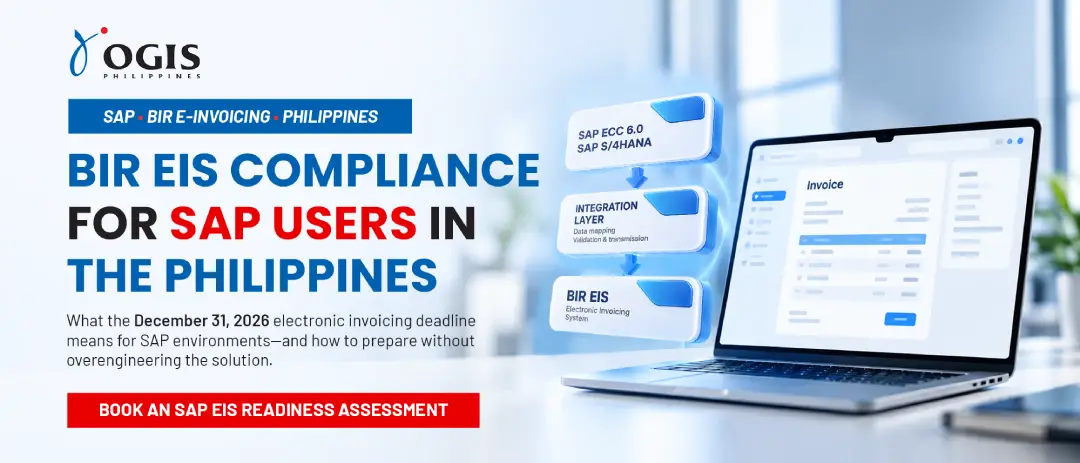
For Philippine businesses using SAP, the move toward electronic invoicing is no longer a distant regulatory discussion. Revenue Regulations No. 11-2025, as amended by RR No. 26-2025, gives specified covered taxpayers until December 31, 2026 to comply with electronic invoicing requirements.
For SAP users, the question goes beyond whether the system can print or email an invoice. Organizations need to assess whether their invoicing process can generate structured, electronically extractable invoice data and prepare the environment for future electronic sales reporting.
Key takeaway
A digital-looking invoice is not the same as an electronically ready invoice. The underlying data and process matter.
What the December 31, 2026 deadline covers
RR No. 11-2025 identifies covered taxpayer groups, while RR No. 26-2025 extends the electronic invoicing compliance period for the listed taxpayers until December 31, 2026.
December 31, 2026
Compliance deadline for listed covered taxpayers.
Electronic invoices
The immediate requirement is electronic invoice issuance.
The immediate deadline concerns the issuance of electronic invoices. The broader Electronic Sales Reporting System (ESRS) requirement will apply once the BIR establishes the required system and issues the corresponding regulations.
Planning note
Meet the electronic invoicing requirement now, while designing data and integration so future reporting does not require a rebuild.
Why a PDF alone is not enough
Electronic invoicing is about structured data, not just invoice presentation. For SAP users, this means looking beyond the PDF and assessing how invoice data is generated, structured, validated, and extracted.
- PDF — Presentation
- SAP — Source data
- Map — Structure
- Check — Validate
- Ready — Integration
Can SAP support BIR EIS readiness?
SAP already contains much of the customer, billing, accounting, tax, and transaction data needed for electronic invoicing. However, having the data in SAP does not automatically make the environment BIR EIS-ready.
Organizations still need to determine how required invoice data will be extracted, mapped, validated, and prepared in the required structured format. Depending on the SAP environment, this may involve SAP integration technologies, APIs, middleware, or custom development.
- SAP — Invoice source
- Extract — Required fields
- Map — Structured data
- Validate — Rules and exceptions
- Integrate — BIR-ready path
Implementation principle
Use existing SAP capabilities where possible. Integrate where necessary. Customize only when required.
What changes across SAP environments?
SAP ECC 6.0
SAP ECC 6 environments may have existing customizations, invoice forms, and interfaces that need to be considered. For companies planning to move to S/4HANA, the EIS approach should also consider the future migration so that today's integration does not create unnecessary rework.
SAP S/4HANA
SAP S/4HANA provides more modern integration and extensibility options. However, BIR EIS readiness still requires organizations to identify the right invoice data, address any custom processes, and determine how the required structured data will be prepared and integrated.
Seven workstreams for SAP EIS readiness
01 Regulatory Scope
Confirm covered entities, branches, transactions, and invoice types.
02 Process Review
Map invoices, adjustments, cancellations, returns, and connected systems.
03 Data Readiness
Trace required data and address missing or inconsistent information.
04 Solution Architecture
Define extraction, structure, validation, APIs, middleware, and custom needs.
05 Controls & Monitoring
Set ownership, exceptions, reconciliation, security, and audit controls.
06 Testing & Deployment
Test standard and exception scenarios without disrupting billing.
07 Support & Change
Train users and define responsibilities across Tax, Finance, IT, and partners.
Not sure where your SAP environment stands?
Start with an SAP EIS Readiness Assessment. Identify gaps before implementation.
Assess your readinessFrequently asked questions
Are all SAP users required to comply by December 31, 2026?
No. Coverage depends on the taxpayer’s classification, transactions, and applicable BIR requirements, not simply on the use of SAP.
Is an SAP system automatically BIR EIS-ready?
Not necessarily. Organizations should assess how invoice data is generated, extracted, mapped, validated, and integrated, including custom processes and connected systems.
Do SAP users need to replace their existing ERP?
Not necessarily. The goal is to use existing SAP capabilities where possible, integrate where necessary, and customize only when required.
Where should SAP users start?
Start with an SAP EIS Readiness Assessment to identify regulatory, process, data, integration, and system gaps before implementation.
Why start with an SAP EIS Readiness Assessment?
Starting with a specific technology before understanding the requirements can create unnecessary complexity and rework. An assessment establishes which processes are affected, where invoice data comes from, what SAP can already support, and where integration or customization may be needed.
The result is a practical roadmap connecting BIR requirements, SAP capabilities, data, integration, controls, testing, and business continuity.
How OGIS Philippines can help
Assess
SAP landscape and gaps
Design
Data and integration approach
Prepare
Controls, testing, and roadmap
OGIS Philippines can help assess the existing SAP environment, identify readiness gaps, review invoice processes and data, evaluate integration options, and define the appropriate approach for extraction, mapping, validation, controls, and testing.
Prepare your SAP environment for the 2026 deadline
Book an SAP EIS Readiness Assessment. Identify gaps, understand options, and define next steps.
Book an SAP EIS Readiness AssessmentSources and further reading
Book an SAP EIS Readiness Assessment
Identify gaps. Understand options. Define next steps.